Do Cry toxins work similarly in different insects?
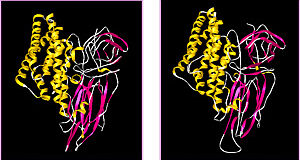
Most of what we know about how Cry toxins work is derived from Lepidoptera models. Considering that the 3-dimensional structure of Cry toxins is highly conserved (see figure below), we would predict that the mode of action of Lepidopteran and Coleopteran-specific Cry toxins is very similar. However, not much is known about the mode of action or the toxin receptors involved in Cry intoxication in Coleoptera.
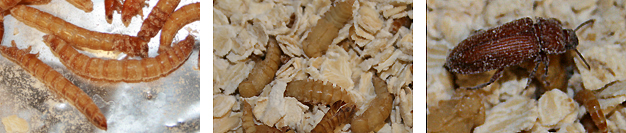
We are collaborating with Dr. Brenda Oppert (USDA-ARS GMPRC, Manhattan, KS), Dr. Marce Lorenzen (North Carolina State University), and Dr. Jeff Fabrick (USDA-ARS ALARC, Maricopa, AZ) in a project aimed at characterizing the mode of action of Coleoptera-specific Cry toxins. We are using Tenebrio molitor (susceptible) and Tribolium castaneum (non-susceptible) as insect models, and Cry3Aa as the Coleopteran-specific toxin. Availability of the T. castaneum genome, and T. molitor genomic resources is allowing us to use both functional genomic and proteomic aproaches to characterize the intoxication process and identify insect molecules involved in Cry3Aa susceptibility, including functional Cry3Aa toxin receptors.
Results from this research will help us screen for and design effective Coleopteran-specific Cry toxins, understand the mechanisms of resistance that insects may develop against these toxins, and contribute to the main goal of developing highly specific, and environmentally sound Cry-based Coleopteran control technologies.
Publications related to this work
Oppert, B., Dowd, S. E., Bouffard, P., Li, L., Conesa, A., Lorenzen, M., Touytges, M., Marshall, J., Huestis, D. L., Fabrick, J., Oppert, C., and J. L. Jurat-Fuentes (2012) “Transcriptome profiling of the intoxication response of Tenebrio molitor larvae to Bacillus thuringiensis Cry3Aa protoxin” PLoS One 7(4): e34624. PDF
Gao, Y., Jurat-Fuentes, J.L., Oppert, B., Fabrick, J.A., Liu, C., Gao, J., and Z. Lei (2011) “Increased toxicity of Bacillus thuringiensis Cry3Aa against Crioceris quatuordecimpunctata, Phaedon brassicae and Colaphellus bowringi by a Tenebrio molitor cadherin fragment” Pest. Manag. Sci. 67(9): 1076-1081. PDF
Morris, K., Lorenzen, M.D., Hiromasa, Y., Tomich, J., Oppert, C., Elpidina, E.N.,Vinokurov, K., Jurat-Fuentes, J.L., Fabrick, J., and B. Oppert (2009) “Tribolium castaneum larval gut transcriptome and proteome: a resource for the study of the coleopteran gut” J. Proteome Res. 8(8): 3889-3898. PDF
Fabrick, J., Oppert, C., Lorenzen, M.D., Morris, K., Oppert, B., and J. L. Jurat-Fuentes (2009) “A novel Tenebrio molitor cadherin is a functional receptor for Bacillus thuringiensis Cry3Aa toxin” J. Biol. Chem. 284: 18401-18410. PDF
Patent Application (2008): Oppert, B., Fabrick, J., Oppert, C., and Jurat-Fuentes, J.L. “Novel cadherin receptor for potentiating Bt biopesticides”.