Funded by: 
This material is based upon work supported by the National Science Foundation under Grant No. 0718807. Any opinions, findings, and conclusions or recommendations expressed in this material are those of the author(s) and do not necessarily reflect the views of the National Science Foundation
How does the insect gut epithelium recover from intoxication?
Numerous pathogens use the insect gut epithelim as the target tissue. Even though much is known about gut regeneration during larval molting, our model for the specific responses involved in gut healing after intoxication is incomplete. It is well established that insect gut regeneration is based on stem cell proliferation and differentiation, yet the specific pathways involved in this process are not characterized. Additionally, enhanced gut regeneration has been hypothesized as an effective mechanism of insect resistance to virus and Cry toxins from Bacillus thuringiensis. Our project, funded by the National Sciences Foundation, is aimed at identifying growth factors involved in gut epithelium regeneration and the role of the gut healing process in resistance to Cry toxins using Heliothis virescens as model. Based on previous observations, our current hypothesis is that Cry1Ac intoxication induces secretion of specific growth factors that activate gut stem cell proliferation and differentiation to overcome the injury:

Our first goal: identify growth factors involved in gut healing response
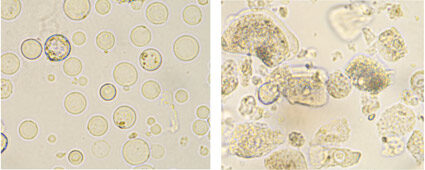
Our approach is based on purification and characterization of the secreted proteins (secretome) from gut primary cell cultures from H. virescens larvae after treatment with Cry1Ac toxin. To detect bioactivity of purified secretome fractions, we use a flow cytomer-based method that monitors stem cell differentiation.
Our second goal: characterize gut regeneration as a resistance mechanism to Cry toxins
Larvae of the CXC and KCB strains of H. virescens display resistance to Cry toxins and enhanced midgut healing after Cry1Ac intoxication (Martinez-Ramirez et al., 1999). Using our method to monitor for stem cell differentiation, we are testing the role of enhanced gut healing in resistance to Cry toxins in these H. virescens strains.
Expected outcomes
The proposed research will answer important questions on stem cell regulation and the role of midgut healing in resistance to Cry intoxication. The most significant outcome will be the identification of factors that activate midgut epithelium healing by induction of stem cell proliferation and differentiation. This information will greatly enhance our ability to develop stable midgut cell cultures and identify key targets for the development of novel insecticides. Additionally, since vertebrate and invertebrate regulatory systems are comparable at the cellular level, we expect that our results may also contribute to the identification of factors regulating stem cell proliferation and differentiation involved in intestinal epithelium regeneration in alternative systems
Publications from this work
Castagnola. A., J. Jackson, O. P. Perera, C. Oppert, S. Eda, and J. L. Jurat-Fuentes (2017) “Arylphorin is a mitogen in the Heliothis virescens midgut cell secretome upon Cry1Ac intoxication” PeerJ, 5:e3886. PDF
Castagnola, A., and J. L. Jurat-Fuentes (2016) “Intestinal regeneration as an insect resistance mechanism to entomopathogenic bacteria” Curr. Opin. Insect Sci. 15(1): 104-110. PDF
Castagnola, A., Eda, S., and J. L. Jurat-Fuentes (2011) “Monitoring stem cell proliferation and differentiation in primary midgut cell cultures from Heliothis virescens larvae using flow cytometry” Differentiation 81(3): 192-198. PDF
Castagnola, A., and J. L. Jurat-Fuentes (2009). “Resistance to Cry toxins and epithelial healing”. IOBC/WPRS Bulletin, Vol. 45: 27-32. PDF